
Frederick Wiseman
Acclaimed filmmaker Frederick Wiseman died last week at the age of 96. It was my honor to play a small part in helping him make one of the final movies of his 56-year career.

This is a long essay about my encounter with Frederick Wiseman. I didn’t mean for it to be so long, but I started writing and this is where it led. There are about a dozen people who will be obsessively interested in this, and I did it for them. And for me.
Acclaimed filmmaker Frederick Wiseman died last week at the age of 96. He was the greatest American documentarian in history. And it was my honor to play a small part in helping him make one of the final movies of his 56-year career.
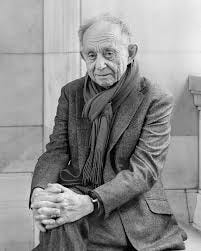
I worked in the mayor’s office in Boston from 2014 to 2021. In the spring of 2018, my friend Yvonne Ortiz, the mayor’s assistant, came into my office, having just sorted the boss’s mail. Yvonne would open it and determine which cabinet chief might be most appropriate to respond to what was received before it got to the mayor. “This is housing-related, it’s for Sheila.” “This is about economic development, John should see it.” “I have no idea what to do with this. I’ll give it to Joyce,” I can imagine her saying.
She came into my office and handed me a letter. “Dear Mayor Walsh,” it started. “My name is Frederick Wiseman, and I’d like to make a movie about City Hall in Boston.” (Or something like that. I don’t know what happened to the original letter, sadly. By law, it would have been archived. I thought there was a copy in my files, but there does not seem to be. I have filed a Freedom of Information Act request to try to get it!)
My eyes grew wide. I looked at Yvonne in something of a panic, and shrieked, “Do you know who this is? Oh my God. Oh my god. Oh my God.” I distinctly remember her laughing at me. She didn’t know who he was, but she said she knew I would know what to do with such a letter.
I have been a fan of Fred’s work since the 80’s, when at the urging of a fellow UMass Boston student in my film class, I signed an affidavit saying I was a social worker (Yes, this was fraud, but the statute of limitations has run out.) so I could see Titicut Follies. That was his 1967 movie that was censored by the Commonwealth of Massachusetts, because they didn’t want anyone to see how badly they were at caring for the people in their charge at the Bridgewater State Hospital for the Criminally Insane.
From there I was hooked and sought to see as many Wiseman films as I could, which wasn’t easy then, before the on-demand viewing of everything under the sun. (It isn’t even all that easy now.) As I sought out these films, I became an even bigger fan. Titicut Follies is an important work, but the ones that I really came to love are those that explore more public-serving civic institutions, or rather the people that make up those institutions. I like the ones that explore process and social interaction. I am most interested in seeing how people navigate systems. He is the master of revealing these things.
I loved his ‘80s, ‘90s, and turn-of-the-century films Deaf, High School II, Public Housing, Belfast Maine, State Legislature, At Berkeley, In Jackson Heights, and when I eventually saw his earlier works like Meat, Welfare, Juvenile Court, Hospital, High School, etc., I was in awe.
I should note that I had JUST seen a few of these in the spring of 2018 when that letter arrived, because Zipporah, his production company, made arrangements to have (all?) his work available on Kanopy, where people with library cards could access them for free streaming. And when I saw Fred’s letter, I had JUST seen his masterpiece Ex Libris, which makes the case that public libraries are central to our democracy – an important idea always, but a revolutionary one in 2017 when it was released. I think it’s my second favorite Wiseman movie, because I love public libraries just a tiny bit more than I love Wiseman films.
I wrote immediately to the email address on the letter, and invited Fred to come meet at City Hall. I reached out to the other four out of 19,000 City employees who would understand why it was our obligation to make sure that Frederick Wiseman got what he asked for. They were as excited as I was.
We met with Fred and his longtime producer Karen Konichek. It turns out that Fred had read a 2017 article in Politico called America’s 11 Most Interesting Mayors, and he had written to six of them with the same request. Two said no. Three didn’t answer. And the other was us. He told me the names of the others. I won’t say who they were, except to mention that I filed away the fact that then-Los Angeles Mayor Eric Garcetti, who, I believe, never met a camera he wasn’t drawn to, had neglected to respond. I knew this might prove a useful tidbit.
We all told Fred how much his work had meant to us.
He explained how it would work. He and his two-person crew (the brilliant cinematographer John Davey, and assistant cameraperson James Bishop) would be in City Hall and other city buildings for about six weeks, hoping to freely film whatever they found interesting. He said he would expect to shoot about 150 hours of footage. They would need a liaison team to help them orient those who might be filmed, and to decipher meeting schedules, and introduce them to people who would give them access to non-public parts of the buildings.
He expressed specific interest in the Mayor’s office, Police, Fire, Boston Public Schools, Public Works, and Inspectional Services, and also said they would be very interested in a community meeting schedule. They needed some storage space in City Hall for equipment. They would want to spend time setting up to get the best audio, meaning there might be directional mics on conference tables. We would have to post signage letting people know that by entering the building, they were consenting to being filmed.
Fred explained the ground rules. He hoped that people would act as if the crew was not there. He said that if there was a situation where something needed to be off the record for some reason like privacy or security, we could ask the crew not to film it. But we could not ask after the fact to keep something off the record.
There was Fred Wiseman, in my office, with my handful of film-loving colleagues. Being part of the Mayor’s senior staff affords a person all kinds of privileges, and I met lots of VIPs while I was there. But this was a dream for me. (The only other celebrity that came close for me was President Biden’s rescue dog Champ. I spent a whole morning playing with him once while my boss and the future president met.)
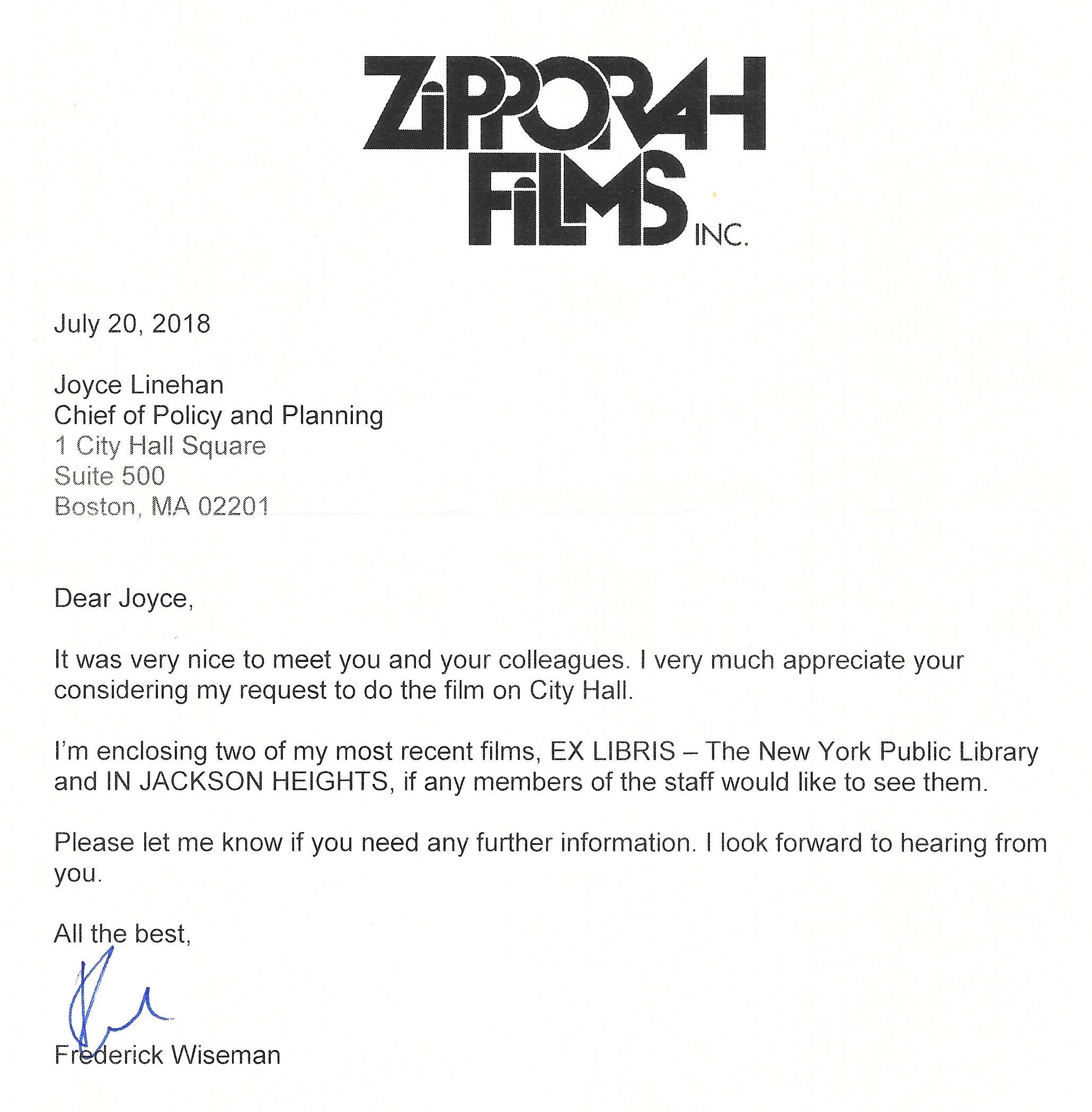
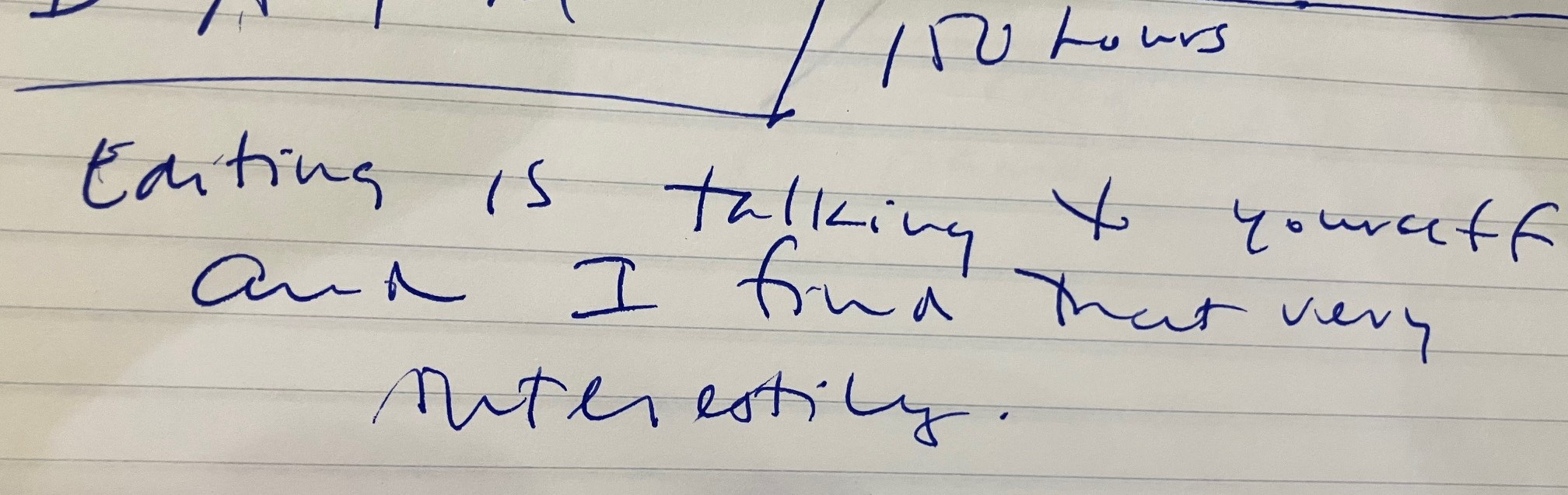
I looked back in my spiral notebooks, and I didn’t take a lot of notes in that first Wiseman meeting, but I did write down one thing he said.
Immediately after the meeting, I went to the Mayor. I found him alone in his office, which was a rarity and the ultimate luxury for me. (I took it as a sign from the film gods.) I told him that the most celebrated documentary filmmaker in the world wanted to make a movie about our City Hall, and that I saw it as my life’s work to convince him that it was a good idea.
Government organizations in the United States are naturally and rightfully suspicious of the media. (Just as the media is inclined to be suspicious of the government.) I have complicated feelings about all of this, because at a time like the one we are living through now, the press, the fourth estate – when doing its job the way it should be done – perpetuates an important safeguard to our fragile democracy. But in my time in government I had plenty of experience with members of the media who walked in with a thesis and made it fit come hell or high water. I’ve been quoted out of context or just plain misquoted, and I’ve had to explain some data to a person who clearly isn’t understanding what I am telling them. Being at City Hall fundamentally changed my view of the entire sector.
I wish Fred had made a film called NEWSPAPER so I could better understand it.
So, Mayor Marty Walsh, a talented and accomplished politician and leader, and a long-time friend, was always a pretty good sport when it came to trusting me where I had some subject matter expertise and he didn’t. (It’s not a long list, but it does include protopunk anthems, and long anthropological documentaries about civic institutions.) He sensed that I was serious. He didn’t toss me out of his office. I told him Fred would be looking for unfettered access to our world for several weeks. I told him what Fred did, and acknowledged that there were risks, but told him that I thought the piece that would emerge would be a statement on democracy (remember, it’s 2018 at this point), and an exploration of the dignity of public service. I knew our government, like many municipal governments, worked most of the time, and I thought Fred’s camera would capture that. (Spoiler alert: Boy, did it.)
The mayor was dubious about allowing that kind of access. He told me to go talk to the press team. I told him they wouldn’t get it. I might have accused them of being 12 years old. I was no doubt very animated. I said it’s not a press thing. He told me I had to convince them if I wanted it to happen.
The press team, very smart, much younger people who had NO idea about Fred’s place in the pantheon of great art, were predictably alarmed at the proposal, and I got nowhere. I had to go back to the mayor.
I asked Marty to meet with Fred. My Hail Mary pass. I also told him that Fred had reached out to other mayors, and that Eric Garcetti, then the mayor of Los Angeles, hadn’t responded to the letter. Some of you will remember that Boston beat out Los Angeles for the Olympic bid in 2015. Then Boston withdrew, whereupon Los Angeles made a deal to host in 2028. There was a friendly rivalry there.
The mayor agreed to meet with Fred. They met, two sons of Boston, sons of immigrants, students of people, and got on like a house on fire. They talked about Brighton, Fred’s home neighborhood, and Boston Latin School, which Fred attended. They were both charming. They both put on a show. By the time the meeting was over Fred had all the access he asked for.
The filming took place starting in the fall of 2018. We got to see the great Frederick Wiseman wandering around the building wearing headphones, carrying a boom mic and portable recorder. And we got to watch John Davey work. They were everywhere. At some premature point though, they had to stop, because Fred was in pain, and needed hip replacement surgery. A reminder that he was 88 goddamn years old at the time. So, unlike many of his other films, this one was shot over two separate time periods, a few months apart. By the time filming ended, he had turned 89.
One of the greatest things about this experience was that the young team of City workers who acted as liaisons to the film team became invested in the process. They became fans of Fred, and by extension, fans of his work. That meant a lot to me, to be able to turn them on to his great artistry.
When filming was finished, I had only a broad sense of what they had shot, and I really only knew about the instances where I was asked to intervene because a colleague was nervous and needed to know the Mayor’s office had sanctioned this access.
In a lot of ways, they really had managed to fade into the woodwork (or cement work, if they were in City Hall). You can see it in the unguarded moments. Capturing the quotidian beauty of daily life and work is signature Wiseman. It could be that his film subjects are more focused on things they think might appear dramatic, not realizing that it’s the moments in between that he uses to stitch together the tapestry. I don’t know.
In February 2020, months after filming wrapped, Fred reached out to ask if I wanted to see the rough cut. I refrained from yelling “ARE YOU KIDDING ME?” A colleague, the mayor’s speech writer, Eoin Cannon (a fellow Wiseman devotee) and I made a rainy-day trip to Porter Square, Cambridge, to Fred’s office. And we sat in front of a computer screen for four-and-a-half hours, rapt. I logged the scenes in a notebook, because I wanted to note the scenes, as well as the people who were in those scenes, so I could give them notice that they were to be immortalized in a film by a master.
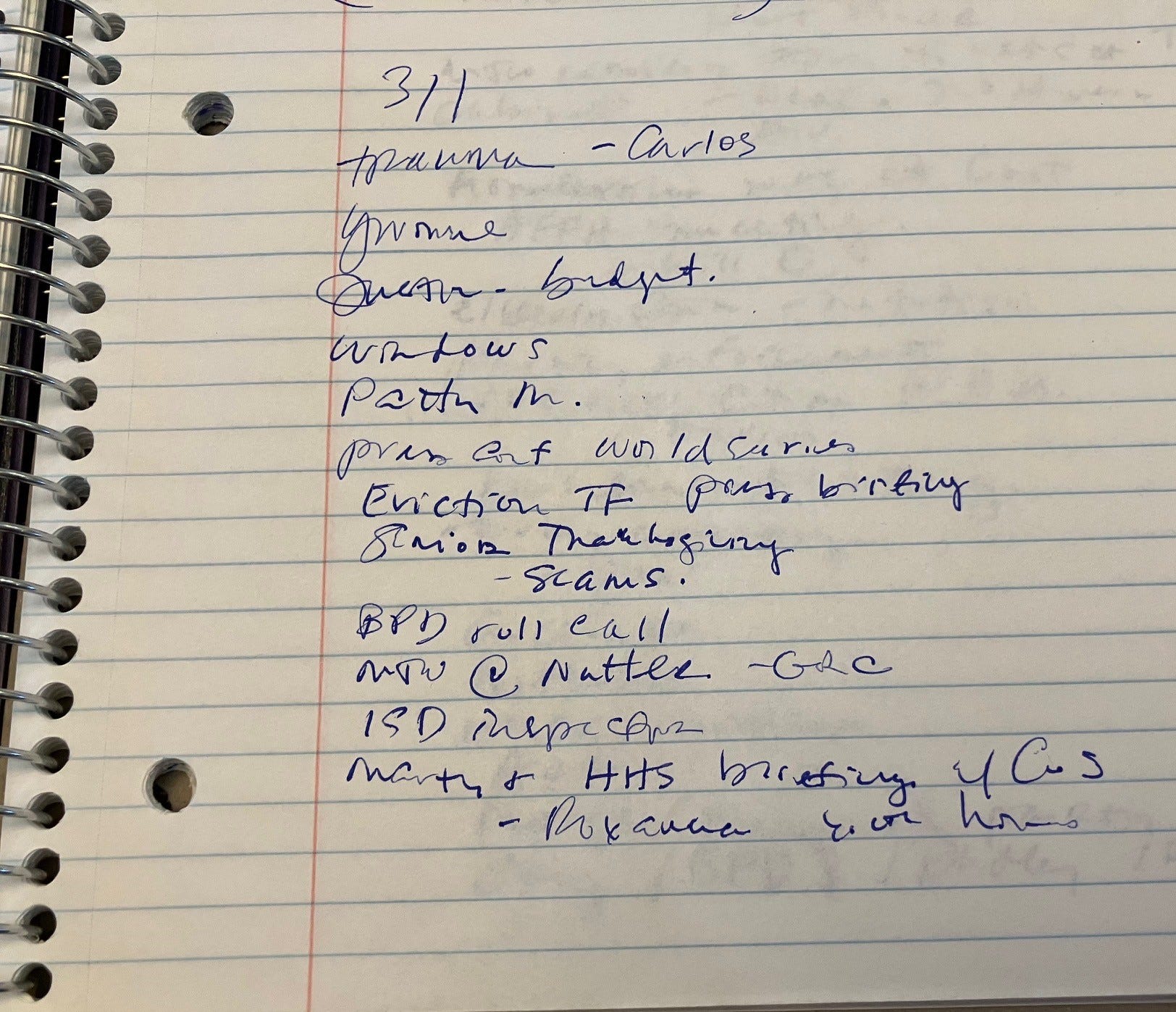
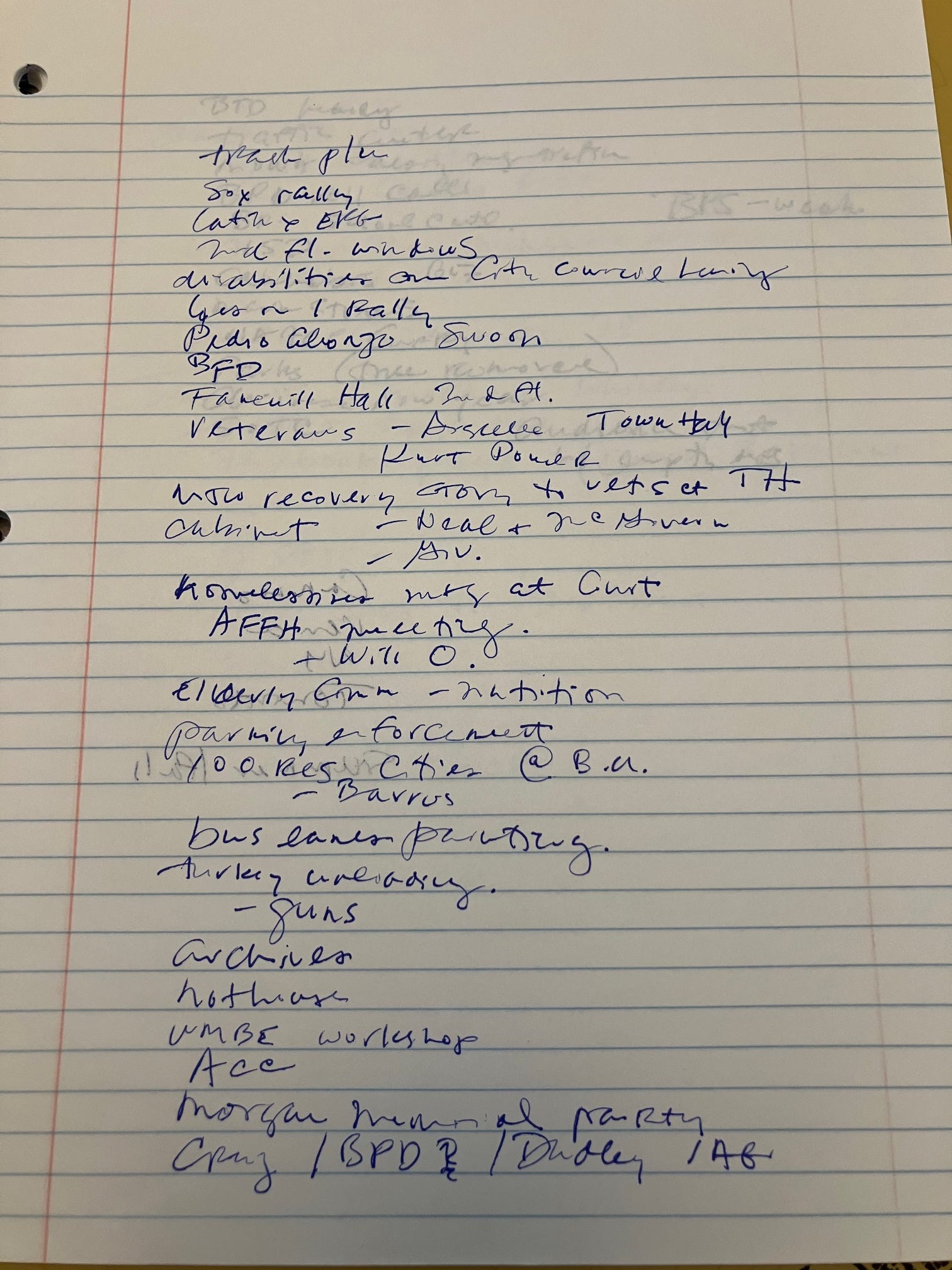
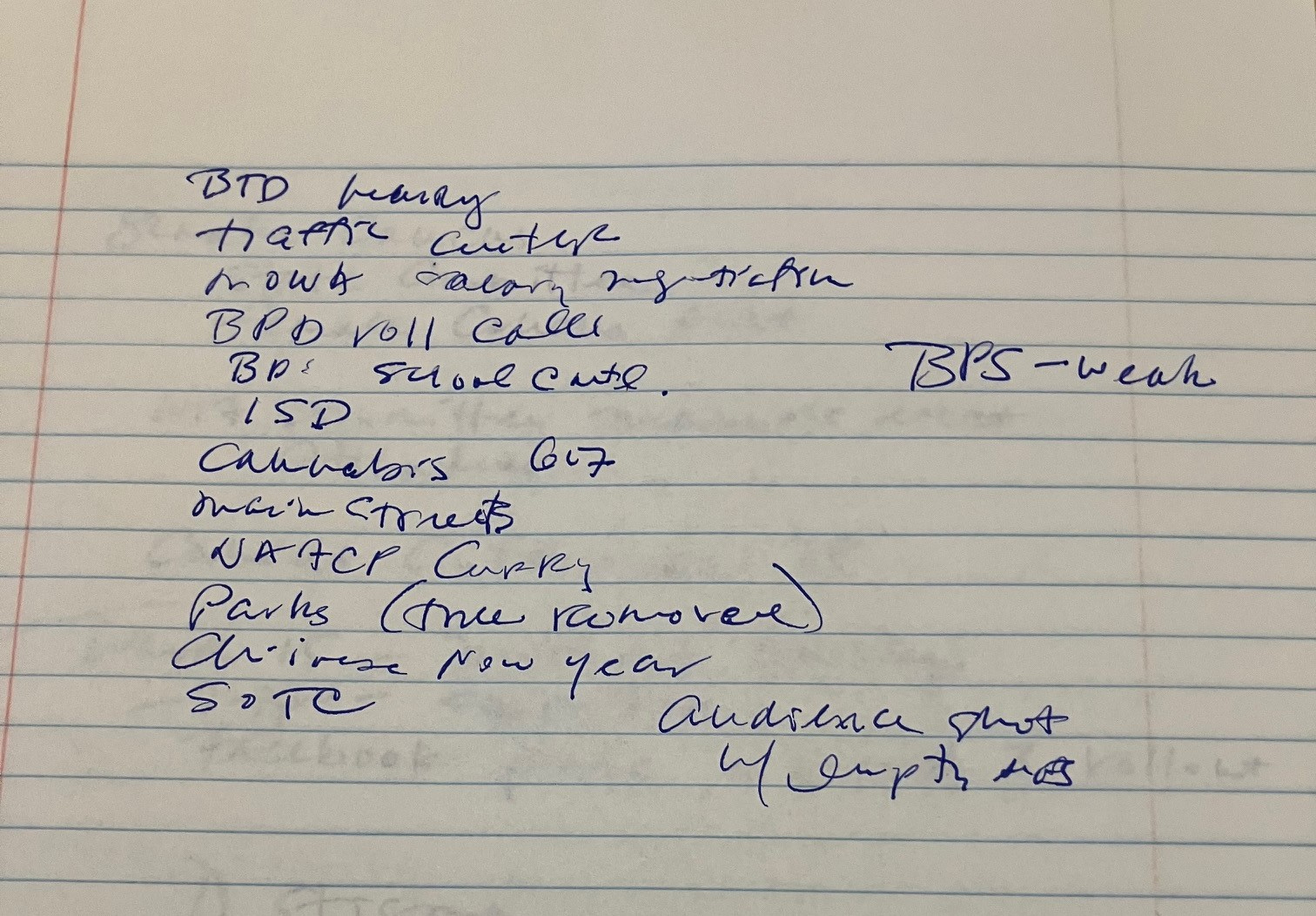
(Apparently I thought the BPS sequence was weak!)
The film, as you may know, is a treasure. I heard from many people who planned to watch it in three or four chunks because it’s long, but found themselves riveted and finished it in one sitting.
There are SO MANY revealing and moving scenes that paint a picture of the nobility of public service. They illustrate the ways in which government takes care of its people, and also shine a light on its limitations.
Fred has said he didn’t plan it this way, but a couple of years into a Trump presidency, CITY HALL is the functioning-government antithesis to a federal administration that was utterly dysfunctional. Most people saw CITY HALL during the endless waves of the COVID pandemic, which the Trump administration was completely ill-suited to address. People were dying preventable deaths. We were seeing in real time what it meant for a government to fail its people.
In City Hall, we see government responding to the needs of city residents. The fact that Wiseman doesn’t use narration or lower thirds graphics just adds to the power. While it is certainly true that his point of view comes through in the editing, his practice of letting the camera linger allows the viewer a perspective they could not get anywhere else – not even in the room.
In some scenes, the humanity of city workers shines through in a way that no one would ever be able to articulate in words. One of my favorites is a scene in which an Inspectional Services worker is called to the home of an elderly disabled veteran who has a rat infestation. In a remarkable six-minute encounter, the man, living in something that looks to the camera like squalor, talks to the inspector, starting with the rodent problem, and then moving on to problems with his landlord siblings who want to evict him, his divorce, his medical issues, his regrets. “My spirit is broken,” he tells the inspector. The inspector listens with empathy, treating the man with dignity and respect, saying he will talk to the man’s landlord siblings. He offers his cell phone number. He says he will follow up. At the end the of the scene, the veteran agrees to let someone in to fix the problem. He tells the inspector he will, saying “I don’t want to live like this.” This multivalent revelation causes my eyes to well up every time I see it.
I don’t know what happened to the veteran, but I think the inspector, by treating the man as a human being, made at least that one day a little bit more bearable. And THAT is not in the job description.
Another scene that I love – and probably the one most people talk to me about – is the trash collection scene in Charlestown. It’s pure poetry, with a beautiful, rhythmic soundtrack, and as satisfying a payoff as I’ve ever seen in any action movie sequence. It’s exquisite. He creates startling beauty out of the ugly ordinary. He makes trash collection, that most fundamental of municipal services, a heroic adventure. I won’t say any more. Just watch it. (It starts at about 55 minutes in.)
I am actually IN the film, in a pretty long sequence that captures a meeting in my office. Six or seven of my colleagues and I are meeting with a public art curator who is interested in doing some work in a Boston neighborhood that hosts a critical mass of services for people with substance use disorders and mental health challenges. The locals call it Mass/Cass (for the cross streets), and it has become a flashpoint – an impossible situation for a neighborhood shouldering an unfair burden, people in need of help, and government leaders who can’t find a solution. In the sequence, we have a long conversation about whether we can do a public art installation with an artist whose parents were addicted to heroin. The project didn’t happen, but the conversation illuminated the intractability of the problem and our desire to shape the narrative in a way that revealed the complexity and the humanity.
The sound, as in many Wiseman films, is beautiful music made up of sounds not normally thought of as musical. Just as there is no narration, and no titles to identify people and settings, there is no non-incidental music in Wiseman films. And yet, they are innately musical. He actually did the sound recording himself. I once asked him if he was trying to create music out of sound. He said, “Well yes, if you hear that.”
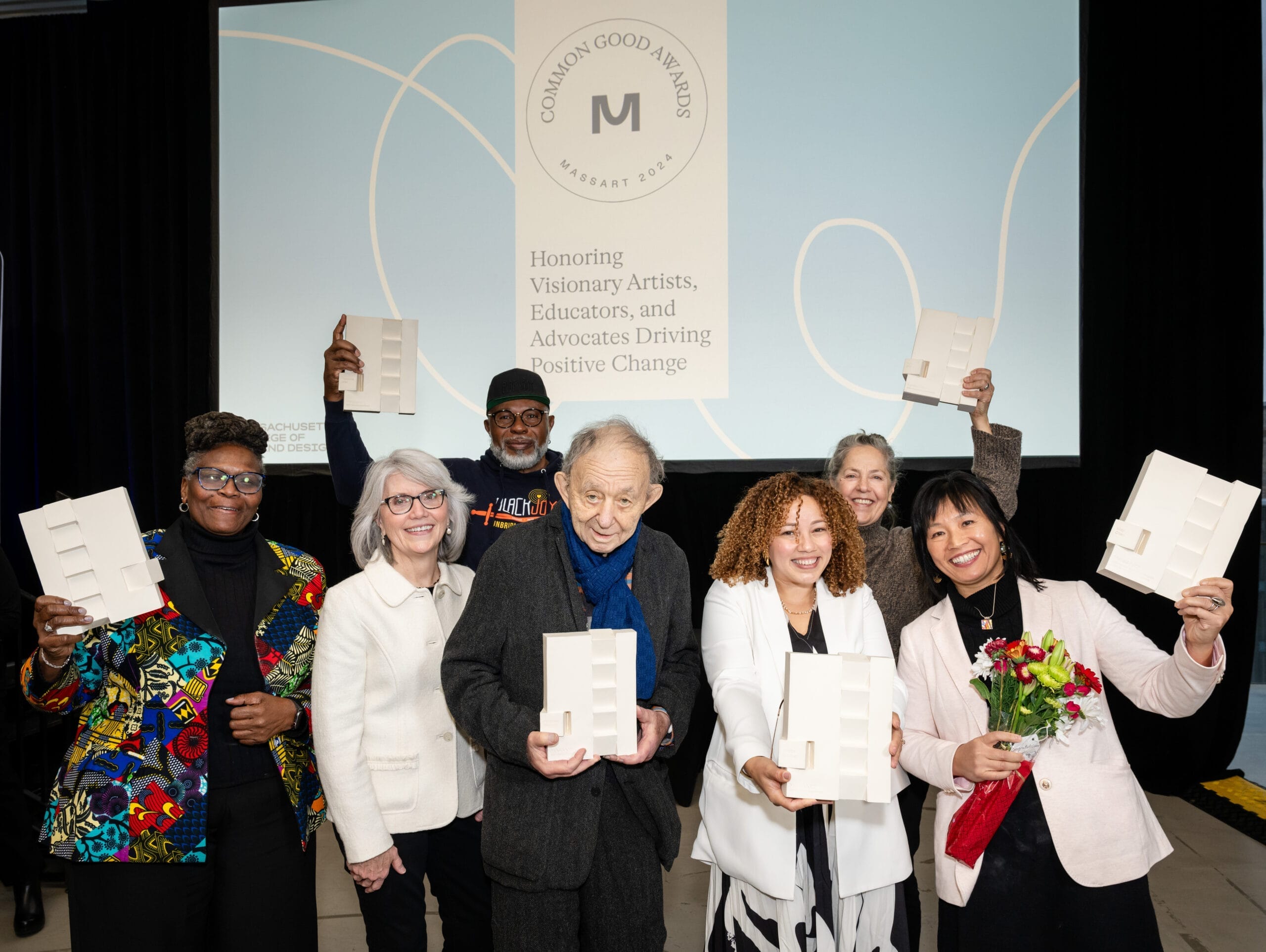
In 2024, after I’d left City Hall, I was working at the Massachusetts College of Art and Design, and the college wanted to honor Fred for his lifetime of work. We made a little video to be shown at the awards ceremony, and in it, former Boston Globe film critic Ty Burr says that Fred’s movies are what we should show the aliens when they land here on earth, because they explain us. He is right.
The last time I saw Fred in person was at that ceremony, in December 2024, but we spoke a few times after. He was concerned about the state of our country.
In 1971, Fred did an interview with PBS that I didn’t see until it was posted on the internet last week after he died. I wish I had seen it back then. I was just a kid in 1971, but if I had seen it, I would have at least had some warning that 45 years later, when I had the big job in the mayor’s office in Boston, Fred Wiseman would come knocking to make this movie.
I am so grateful for the time I have spent with Fred’s movies over the years, and then for the opportunity I had to meet him and play a small role in facilitating such a great film.
I am also looking forward to his next film, AFTERLIFE, which I hear will open in Venice later this year.
Joyce Linehan, February 2026
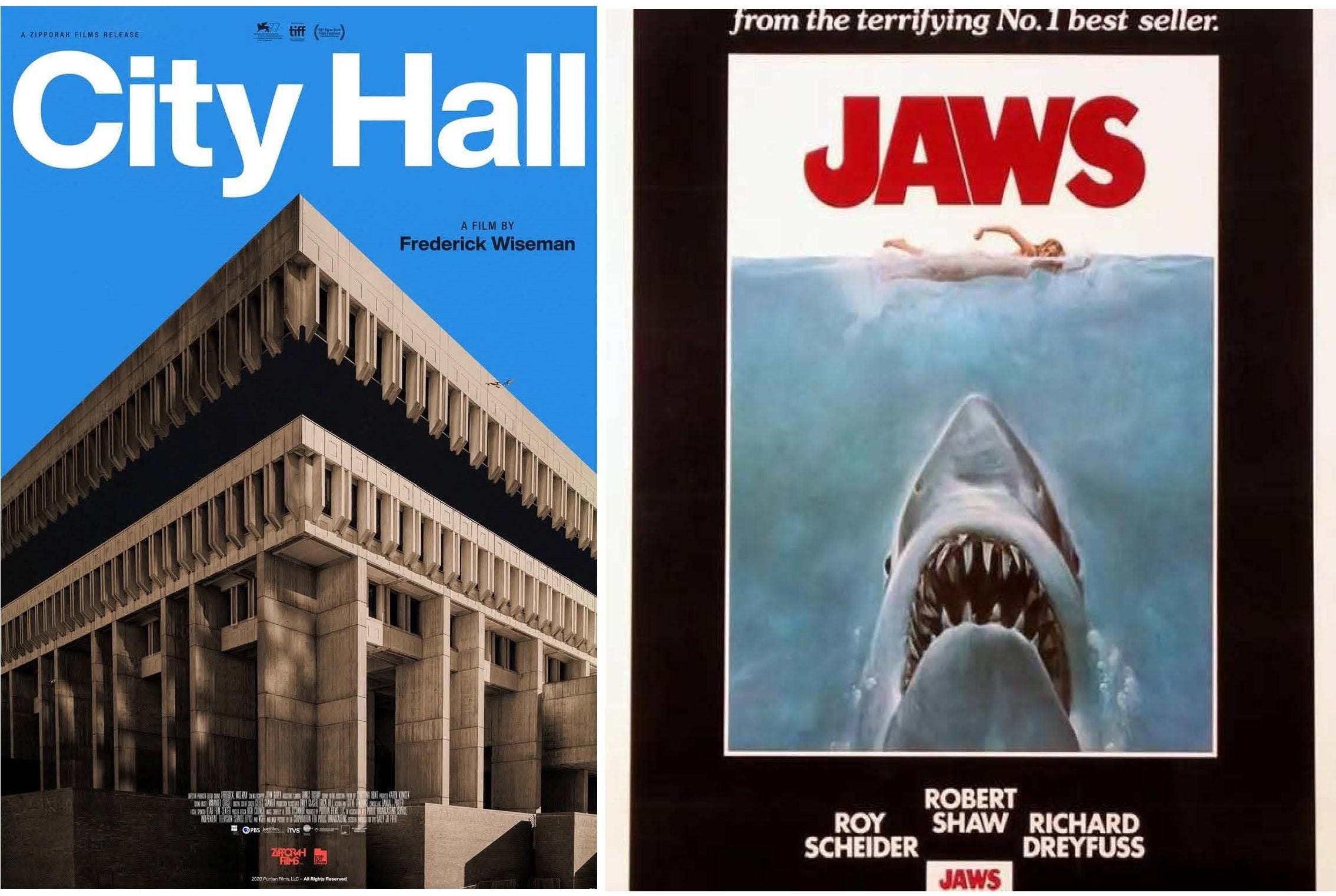
You see it too, right?
*******************
I also write another Substack, with a soundtrack, over here.
Terrific post, Joyce. When I interviewed Wiseman, he was effusive about how pivotal your support had been in making the film happen.
Great essay my friend. Your commitment to art and public commentary and to beings is a thing to behold. Thank you!